
WDCR Autocross
Autocross is a relatively low-speed competition in which one driver at a time negotiates sweeps and turns defined by cones.
Next event
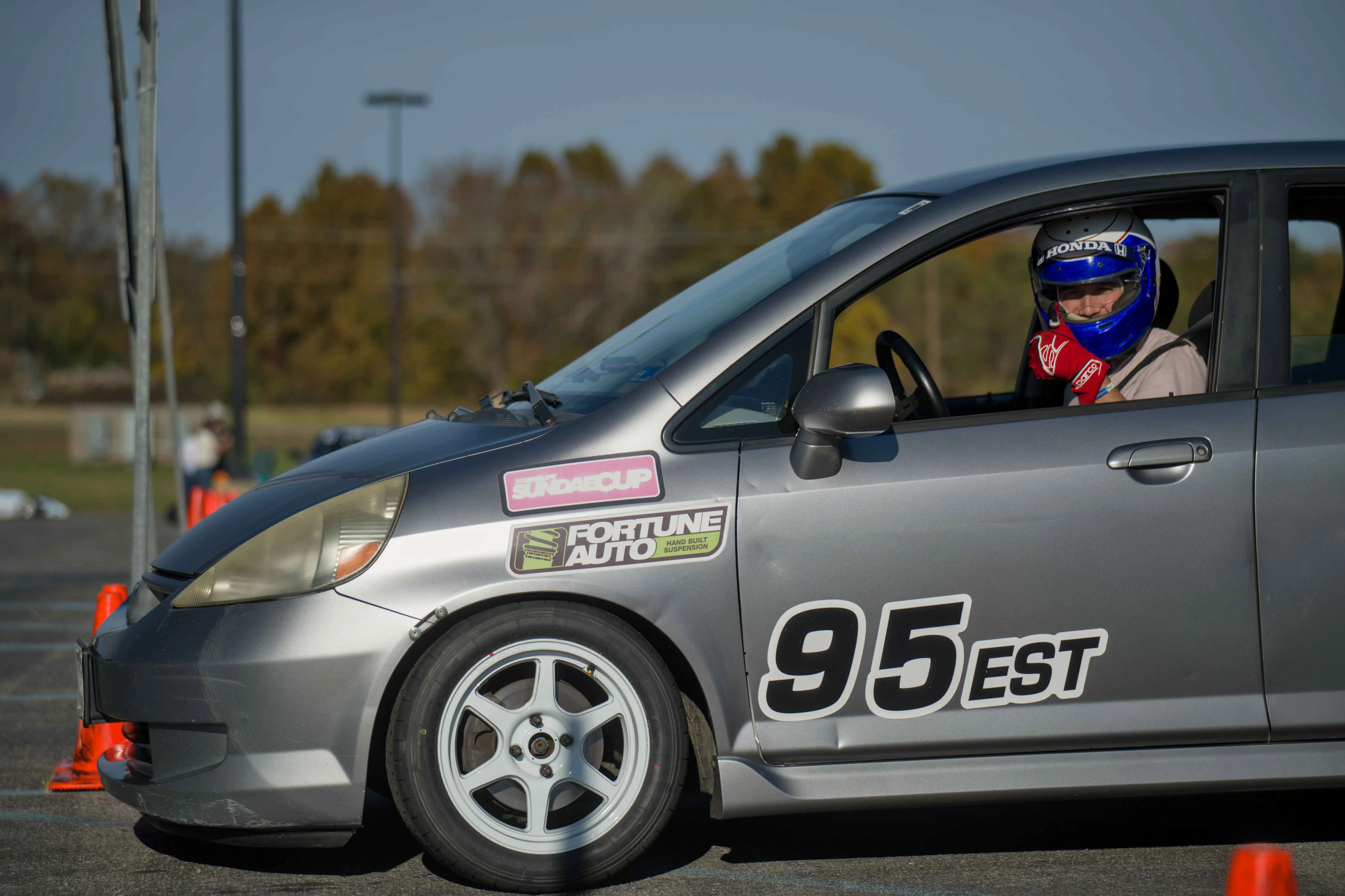
Join us for Autocross!
Autocross is a relatively low-speed timed competition in which one driver at a time negotiates sweeps and turns defined by cones.
Stay informed and ahead of the curve! Please subscribe to our weekly newsletter to receive the latest updates on all our regional events and announcements. Delivered to your inbox every Sunday evening, this is our primary channel for sharing crucial, timely information.
Questions or comments? Email the Autocross program chair.
Program contacts
- Chair: Ryan St. Louissolochair@wdcr-scca.org
- Assistant Chair: Tom Carrollsolochair@wdcr-scca.org
- Novice Coordinator: Mike McKee
- Autocross School Director: Brian Garfield
2026 Autocross/Solo Event Calendar
No upcoming events. Check back after the schedule is sanctioned.
Earlier this season (17)
- WDCR 2026 AX Championship Event #7
- WDCR 2026 AX Event #8 VETMotorsports fundraiser
- WDCR 2026 AX Championship Event #6
- WDCR 2026 AX Championship Event #5
- Wash DC Region 2026 Solo August TEST-and-TUNE
- WDCR 2026 AX Championship Event #4
- Wash DC Region 2026 Solo SCHOOL July Level 2
- Wash DC Region 2026 Solo SCHOOL July Level 1
- WDCR 2026 AX Championship Event #3
- WDCR 2026 AX Championship Event #2
- Wash DC Region 2026 Solo SCHOOL May Level 2
- WDCR Pre-Pro Dust Off Special & NEDIV Divisional
- WDCR 2026 AX Championship Event #1
- Wash DC Region 2026 Solo April TEST-and-TUNE
- Wash DC Region 2026 Solo SCHOOL April Level 2
- Wash DC Region 2026 Solo SCHOOL April Level 1
- WDCR 2026 Solo Season Subscription- whole season
Live Timing & Results
What is an Autocross?
The SCCA holds events both locally and nationally called autocross events. An autocross is a relatively low-speed competition driving event in which one driver at a time negotiates a twisty course. Maximum speeds on course are about 60 MPH in production-based vehicles. The course is defined using traffic cones to make gates that define slaloms and sweeping turns. Scoring is usually based on raw times within classes of similarly equipped vehicles. Runs are timed to a thousandth of a second using sensors at the start and finish.
Autocross is often best described as a competition of precision driving. There is a class for almost any car, and Shifter Karts and Junior Karts can take part too. Karts are not allowed at Regency Furniture (Blue Crabs) Stadium; see the Supplemental Rules for more information. Check the SCCA site for the most current rules.
Run groups
All eligible competition classes are arranged into one session. Competition classes cycle through the available run groups (2 or 3, depending on the number of participants) over the course of the season, so that all competitors run at all possible times of the day.
The Ladies classes run with their respective open classes. Ordinarily, Junior Karts would run as a whole before the 4th heat. Unfortunately, the Junior Kart program is currently suspended at the national level. We hope we can give our young racers a place to play again soon!
The SCCA Autocross Committee reserves the right to adjust class distribution within the session for event balance, and will communicate the run groups after registration closes or at the event.
To find out which run group you are in, click View Entry List (the red car icon) in the event listing on MotorsportReg.com.
What is PAX (RTP) indexing?
RTP stands for “Racers Theoretical Performance”. This index was developed by Rick Ruth and reflects study of results from well over 500 Solo events nationwide, including the Tire Rack® Solo National Championships, National Tour, Alabama Region, Atlanta Region, Chicago Region, California Sports Car Club, Central Florida Region, Equipe Rapide (Florida and Texas), Great Lakes Solo Series, Hawaii Region, Houston Region, Midwest Divisional Series, Milwaukee Region, Minnesota Autosports Club, New England Region, Northwest Region, Northern New Jersey Region, Oregon Region, Philadelphia Region, Rocky Mountain Series, San Francisco Region, San Diego Region, South Jersey Region, St. Louis Region, Tri-State Sports Car Council, Texas Region, Washington DC Region, Wisconsin Autocrossers Inc., and many, many others.
Worker assignments
Every participant is expected to help and volunteer for a worker assignment. See Worker Assignments for details.
What about spectators?
Please review the spectator guidelines.
Other items of interest
- Sweep Walking, by David Lane: how to walk a course.
- Dances with Cones, by David Lane: why autocross.
2026 Autocross event pricing
Entry fees for individual events, as listed on MotorsportReg. A non-member pays $25 more for an SCCA weekend membership, bought with the entry.
| Event | Price |
|---|---|
| Points events | $61 for SCCA members, $86 for non-members |
| Non-competition runs | $44 |
| Level 1 School | $240, plus $25 for non-members |
| Level 2 School | $285, plus $25 for non-members |
| Test and Tune | $150, or $225 with an instructor (SCCA membership required; no weekend members) |
| Season Subscription | $406, or $308 for non-competition runs (SCCA membership required) |
Season Subscriptions
Competitors can register for the WDCR Season Subscription on MotorsportReg.com.
The Season Subscription is pre-payment for all WDCR Solo Championship events. It also lets you select a number within your class for the season. The subscription does not include National Tour events, schools, or optional points events. Season Subscribers also have priority registration for any night events held by WDCR Solo.
The fine print
The Season Subscription is non-refundable and non-transferable. When you scroll to the bottom of the attestation, register, and pay for this subscription, you agree to these terms and conditions.
All event dates are subject to change per contractual agreement with the venue. There are no refunds for events you cannot attend because of an event date change.
The Season Subscription is pre-payment for:
- The WDCR SCCA Autocross Practice Event
- The 7 WDCR SCCA Autocross Championship events
- The opportunity to select a permanent number within your class for the season
You will be pre-registered for each event with the car, class, and number you selected at the beginning of the season. If you change cars or classes, you can select a new number from those remaining in that class.
- National Pro Solo and Championship Tour events are not included in this subscription.
- The Season Subscription is open to SCCA members only. Membership numbers are verified by the system at registration.
- Points earned in other classes are not transferable.
- If you cannot make an event, you must cancel yourself on MotorsportReg.com by the Wednesday before the event, or risk losing your subscription number for the rest of the season.
FAQ's
Where are autocross events held?
The course is generally laid out in a large parking lot or airfield free of obstructions. Washington D.C. Region autocross events are held at a variety of locations; see the Calendar tab for dates and locations. Cone positions are marked on the course with boxes of chalk, drywall, or large crayons. Courses are designed to be both entertaining and safe, and usually take about a minute to drive at speed. Before driving the course, all competitors can walk it to learn the design. Almost no two autocross courses are the same, and learning the course is part of the challenge.
What if I hit a cone?
Each cone hit adds a two-second penalty to the run time. A penalty applies only if the cone is knocked down or moved off its marking on the pavement. If the cone is hit and any part of its base still touches the marking box, there is no penalty.
Will cones hurt my car?
Generally, no. The cones are soft plastic and deform when hit. They occasionally leave slight marks on paint and wheels, which come off easily with car polish.
Do I need a special license to autocross?
No. Most local events are open to the general public and need only a current state-issued driver’s license. Some clubs limit entry to current club members. Most SCCA events are open to the public, and many offer a discount to SCCA members.
Do I need to wear a helmet?
Yes. Insurance rules require every autocross participant to wear a seatbelt and a Snell-approved helmet on all runs. Helmets must meet the current or two previous Snell standards, which change every five years. Helmets with the 2020, 2015, 2010, 2005, and 2000 Snell standards are currently acceptable.
Is my car okay to autocross?
Most vehicles are. The exceptions are vehicles with a high center of gravity, such as SUVs and tall pickup trucks. Virtually all types of vehicles, from station wagons to open-wheel race cars, are welcome at SCCA autocross events. Check the SCCA Solo rules to see where your car is classed. If you cannot find your vehicle, just ask! Every vehicle must pass a general safety inspection and be emptied of all loose items.
Are there sound restrictions?
Yes. A 100 dB limit is measured 50 feet from the course at a high-throttle zone chosen during course setup. Workers at the meter record each run.
Courtesy warnings are given at 97 dB. A competitor who reaches the 100 dB limit gets a chance to fix the problem, and the fix must be approved before they continue.
Records are kept. A driver who keeps bringing a car that breaks the sound limit may have to bring a different car next time.
Is there anything I need to do to my vehicle?
At a minimum, the vehicle must be in good running shape: no leaking fluids, tight suspension and steering, tires in good shape, and solid brakes. Before you compete, remove all loose items from the interior (including the driver’s floor mat), and inflate the tires about 5 to 10 PSI over your usual street pressure. Many competitors bring portable air tanks to adjust tire pressures on site.
What if my car isn’t modified for autocross?
All the better. Modifying your car often places you in a more challenging class. Autocross is mainly about driving, not modifications. Modifications can make a vehicle perform better, but it is the driver who makes the car faster. Which modifications are legal in which classes is beyond what most people need when starting out, but all the details are in the SCCA Solo rulebook and on the national SCCA website if you’re interested.
How much is the entry fee?
See the Pricing tab, and the list of events on MotorsportReg.
How long does an event last?
Most autocrosses are full-day events. Most competitors are there for about half the day, but some stay to watch or work. The location and event format of each Washington D.C. Region event decide whether it runs all day or is split into morning and afternoon sessions.
What should I bring to an autocross?
Gear for the weather. If rain is predicted, bring umbrellas, tarps, and so on. If it is sunny, bring sunscreen and drinks. Food and plenty of water are always a good idea, although some clubs sell food on site. Folding chairs are always useful. Cameras are allowed at most venues.
Does my vehicle need numbers?
Yes. Virtually all autocrosses require easily visible numbers on each vehicle. At WDCR SCCA events, large numbers and class letters on each side are mandatory. Bigger is better, and good contrast helps. Most competitors use magnetic numbers and letters. If you don’t have magnetics or have a non-metallic vehicle, be creative: as long as the numbers and class letters are visible during your runs, you’re fine. Painter’s tape usually works, and if you ask around the paddock, someone is likely to have some.
Can I come to an event and not compete?
Absolutely! We recommend attending at least one event to learn the basics before taking part. You can see how the event flows, watch some runs, walk the course, and talk to the competitors. You may even be able to ride along with a competitor. Novice coordinators are at every event and can help if you decide to jump in with both feet. If you are brand new, ask the gate attendant for the novice coordinator and get connected right away. See also Spectating.
How do I sign up for events?
Online, on MotorsportReg. The Calendar tab lists each event with its Register link.
How do I know what to do when I arrive?
This is where attending an event beforehand helps. Regions run their events a little differently, although most are similar. In the Washington, DC Region, you begin by signing a liability waiver at the entrance. Then you go to registration to sign in, show your driver’s license, and receive your worker assignment for the day. Next, get your car ready, take it through the vehicle safety inspection (tech inspection), and move it to the grid. Walk the course a few times to learn the layout; more walking is always better. Finally, you take your runs and work your shift, not necessarily in that order.
I already paid for the event. Why do I have to work?
Autocross is true grassroots motorsport: entry fees are kept low on purpose so everyone can take part. Much of the saving comes from competitors working the event. If every position at an autocross needed a paid worker, entry fees would skyrocket. At most events, competitors work only an hour or two, and there are many kinds of work assignments to suit different abilities. It can also be an enjoyable way to take part, with views of the drivers that spectators never get. See Worker Assignments.
Are pets and children allowed?
Pets are not appropriate at autocrosses. If you absolutely must bring your pet, make sure it is comfortable and either fully supervised or secured well away from the action. Young children must be supervised at all times, and older children should be told about safety at the event. Insurance rules require a parent or legal guardian to sign a minor waiver at the entrance for every minor. Safety is always the first concern at an autocross. If in doubt, please make other plans for the kids and pets for the day.
What do I win if I drive well?
WDCR gives awards to season points winners; see Awards. Serious prize money and awards are possible at some national events, but they are often offset by entry fees, travel, and equipment for the car.
I’m hooked. How do I learn to get faster?
Practice. Then practice more. Unless you have Mario Andretti’s DNA, you probably won’t be the fastest driver in your class on your first day. Every sport has a learning curve, and autocross is no different. But there is a way to get lots of practice without spending years autocrossing: go to school. The DC Region has a great autocross school program for many skill levels. At a school you can get a whole season’s worth of runs in a single day, and skilled instructors help you find the best way through the course and get the most out of your car.
Like any sport or hobby, you learn the ropes through experience and time. Make use of the wide knowledge of the competitors and committee members. Here are two articles by David Lane, a Spirit of the Sport Award recipient, to get you started: Sweep Walking, on course walking, and Dances with Cones, on the experience.
Autocross Resource Library
The resource library is in Google Drive. Open the Autocross resource library for:
- Archives
- Autocross Supplemental Rules
- Minor Waiver
- Results
- WDCR Autocross Event Safety Plan
SCCA’s annual waivers are signed online: National Waivers.